

Since 1930 this strategy identified 11 long term Sell points. That’s one every 8 years.
Since 1997 if the big down turns were avoided in the SP500 your investments would be a whopping +155% higher.
Buy & Hold – $1,489.70 – baseline
Avoid 2000-02 & 2008 ~$3, 797 +155% higher
Since 1930 Your portfolio would be roughly 1,250x larger than buy-and-hold.
If buy-and-hold turned $1 into $6,000. Avoiding downturns turns $1 into about $7.5 million. You don’t need to beat the market every year. You just need to avoid the catastrophic years. The compounding difference becomes astronomical over 100 years.
As with any disciplined investment approach, beginning early tends to strengthen long-term outcomes.
This Chart highlights long-term buy and sell signals across major market cycles using colored arrows to mark historically significant turning points.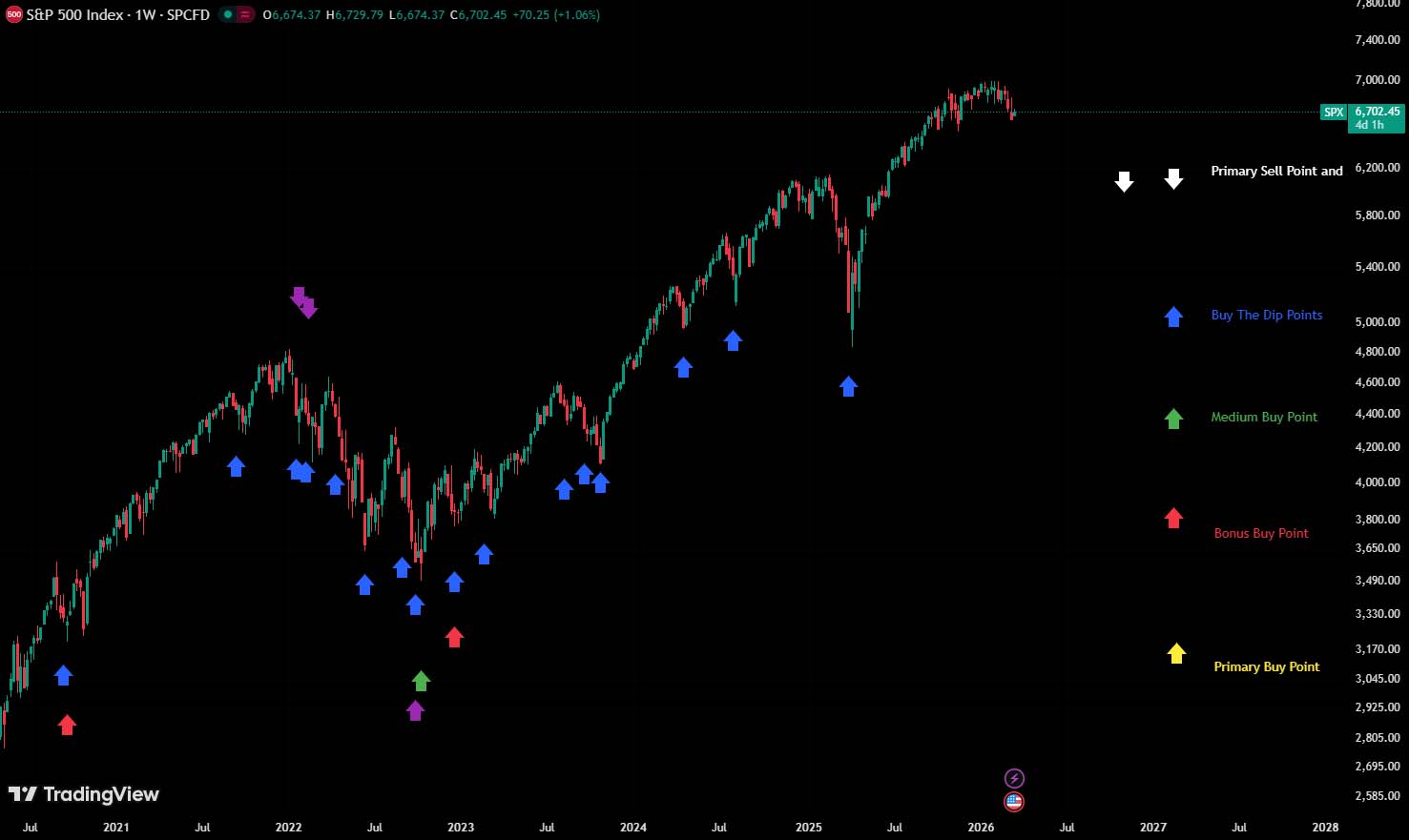
On This Chart:
White arrows above the price pointing down are Primary Sell Points; these indicate possible market tops or sell zones. White arrows below the price pointing up are Primary Buy Points; these indicate the move down is likely over and reentry is suggested.
Magenta arrows above the price pointing down are Secondary Sell Points; these indicate possible market tops or sell zones that usually do not result in as deep of a move down as Primary Sell Points do. Magenta arrows below the price pointing up are Secondary Buy Points; these indicate the move down is likely over and reentry is suggested.
Green arrows indicate a Medium Buy Point; these indicate a great buying opportunity when not following a sell zone.
Red arrows indicate a Bonus Buy Point; these indicate the first buy point following a structural bottom. Blue arrows on the Buy The Dips Chart, suggest potential buy zones or bullish momentum.
Each arrow reflects a moment worth evaluating-not a directive to act immediately.
No. It’s a historical reference map. The signals are based on structural behavior observed over decades, not forecasts or short-term speculation.
Use it to understand where the market was in its long-term cycle at each signal point. It’s a tool for strategic reflection, not rapid execution. Always consult your financial advisor before making decisions.
By Email, along with commentary about the indication.
Because they’re based on deep structural shifts, not short-term volatility. This chart is built for investors who think in years, not minutes.
Not immediately. These signals are designed to give you time – weeks or even a month to evaluate, plan, and act deliberately.
No system is flawless. These signals are based on historical structure and long-term patterns, not guarantees. They’re designed to support strategic evaluation-not predict outcomes.
Signals often emerge at structural stress points, not at the exact top or bottom. They’re meant to prompt reflection and planning, not pinpoint precision.
Yes. Markets are complex and influenced by countless variables. A signal may appear during a temporary pause or reversal that doesn’t lead to a sustained move. That’s why disciplined evaluation is essential. However since the US equity markets are biased in the up direction. This can be corrected relatively quickly and history has shown it results in a nice move up.
Never. Use it as one layer of insight. Combine it with your own analysis, professional guidance, and long-term goals. No single tool should drive your decisions.
That’s normal. Markets evolve. This system is built to highlight historically significant zones-not to control or predict future behavior.
Because perfection isn’t the goal-clarity is. This system helps you see the bigger picture, stay grounded, and act with purpose.
Success comes from self-improvement, discipline, and managing your own psychology, not from beating other traders; it’s about overcoming personal weaknesses, emotional biases (like greed or fear), and sticking to your strategy to improve consistently, rather than getting distracted by market noise or comparison to others, which leads to better, sustainable results.
Diversification: Spreads risk across many large companies and sectors.
Long-term Growth: Historically provides solid returns, helping beat inflation.
Simplicity: ETFs and index funds offer a hands-off, passive investing approach.
Dollar-Cost Averaging (DCA) is one of the simplest, most reliable ways to invest without getting caught up in market noise or emotional decision-making. It aligns beautifully with a philosophy of avoiding split-second reactions and focusing on long-term structure. DCA will work fine in long term uptrending markets mainly because new money is invested a little at a time , however this strategy is designed to move to the sidelines only during long deep downturns and reenter the markets close to the bottom as per historical computation. In this strategy you can DCA as long as the chart is not in a sell situation and save the investment for a much better entry.
If the chart feels “frozen” or locked behind an ad, a quick page refresh will clear the ad, though it will likely reappear later.
Free Account Limitation: The free version of TradingView is supported by ads. These pop-ups or banners appear periodically.
Most services offer stock recommendations based on analyst opinions, earnings momentum, or valuation screens. Their goal is to identify promising companies and suggest when to buy – often with a focus on short-term performance or speculative upside.
Our approach is fundamentally different. We don’t recommend stocks. Individual stocks demand additional layers of evaluation beyond broad market analysis. We provide rules-based signals tied to long-term market structure – not sentiment, forecasts, or opinions.
Our system tells you when to accumulate, when to trim, and when to reinvest based on repeatable patterns that have held across decades. Where others focus on price targets, we focus on share growth.Where others rely on prediction, we rely on structure. Where others offer ideas, we offer a disciplined process. This strategy is built to help investors stay calm, stay invested, and compound over time – not chase headlines or react to market noise.
No. This strategy is designed to reduce noise, not amplify it.
Signals are infrequent and structural – not reactive or time-sensitive. You’ll typically have weeks to act on a signal, and each one is meant to guide long-term positioning, not short-term trades.
You don’t need to check the market daily. You need a clear process – and that’s what this system provides.
Yes – especially if you value long-term growth and behavioral discipline.
This strategy is built to compound share count over time, making it ideal for retirement accounts where reinvestment and tax efficiency matter.
It helps you stay invested through volatility, avoid emotional decisions, and align with the market’s long-term upward trajectory.
Many clients use it as a core framework for IRAs, 401 (k)s, and long-term taxable accounts.
Signals are designed to be clear, infrequent, and slow-moving.
No. A sell signal is not an instruction to liquidate your entire portfolio. It’s a structural alert – an early warning that market conditions have shifted. The purpose is to help you evaluate your positions, not to force an all-or-nothing decision.
Treat it as a prompt to review your holdings with intention. If the instruments closely mirror the SP500 look at which positions were purchased below the current sell-signal price and which were purchased above it. Many long-term, rules systems-including yours-only sell shares that are currently in profit and hold any shares that would be sold at a loss.
Because selling everything introduces unnecessary timing risk. Markets often continue rising for weeks or months after a signal. A disciplined system avoids emotional, all-in/all-out decisions and instead focuses on protecting gains while letting long-term positions compound.
This is where your rules matter. Consult your financial advisor. As long as the positions closely mirror the SP500 In your model, you only sell shares purchased below the sell-signal price and keep any shares purchased above it. That keeps you from selling at a loss and maintains long-term exposure. This keeps you invested during those infrequent times the market sentiment changes and the SP500 rebounds.
Absolutely. A sell signal gives you time – often weeks – to review your situation with a professional and decide what fits your long-term plan.
Yes. You can opt out at any time on a pro-rated monthly basis.
You’re never locked in. If you choose to step away, your membership simply ends at the close of your current month, and any unused portion is adjusted accordingly. We don’t like to see anyone go, but your financial journey is always your choice – and we encourage you to stay engaged, stay informed, and keep a steady hand on your long-term investments.